
Interiors
The rawness of industrial solutions will meet the warmth of natural materials, and each room will become a stage for future cultural events. The space, divided into functional zones, will create a thoughtful dialogue between artistic vision and rigid engineering forms.
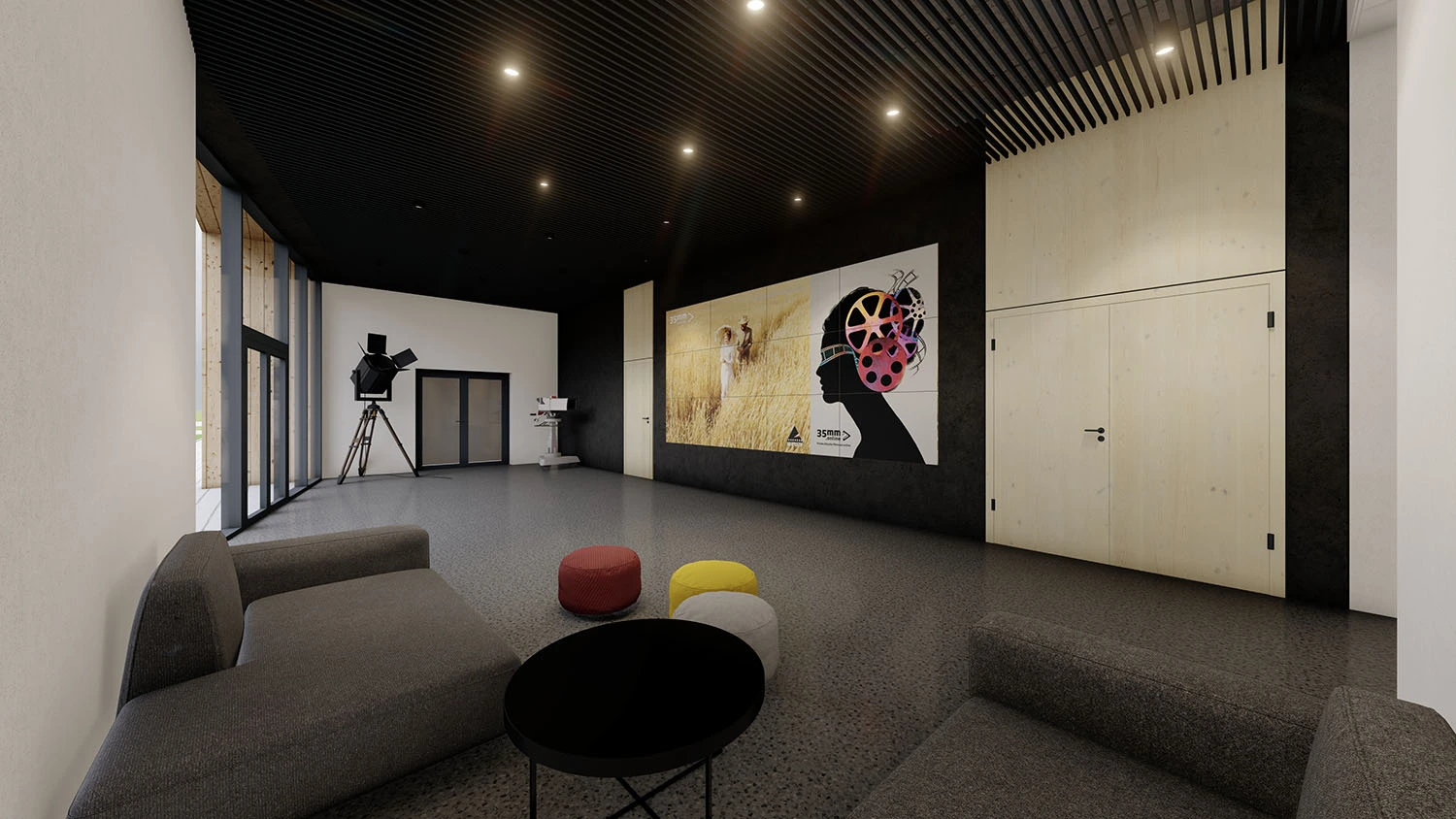
The film education area will be located in the northeast wing, while the exhibition and workshop zone will be located in the southwest wing. Both sections will be connected by a glass link, housing the main entrance to the building, providing barrier-free access for children and people with mobility impairments. The entrance will be accessible both from the public space on Kierbedzia Street and from the WFDiF premises.
Thanks to a 3D interior presentation, we can already step inside the Educational Center. Watch the video:
the building
-
Café: The Industrial Heart of Social Life
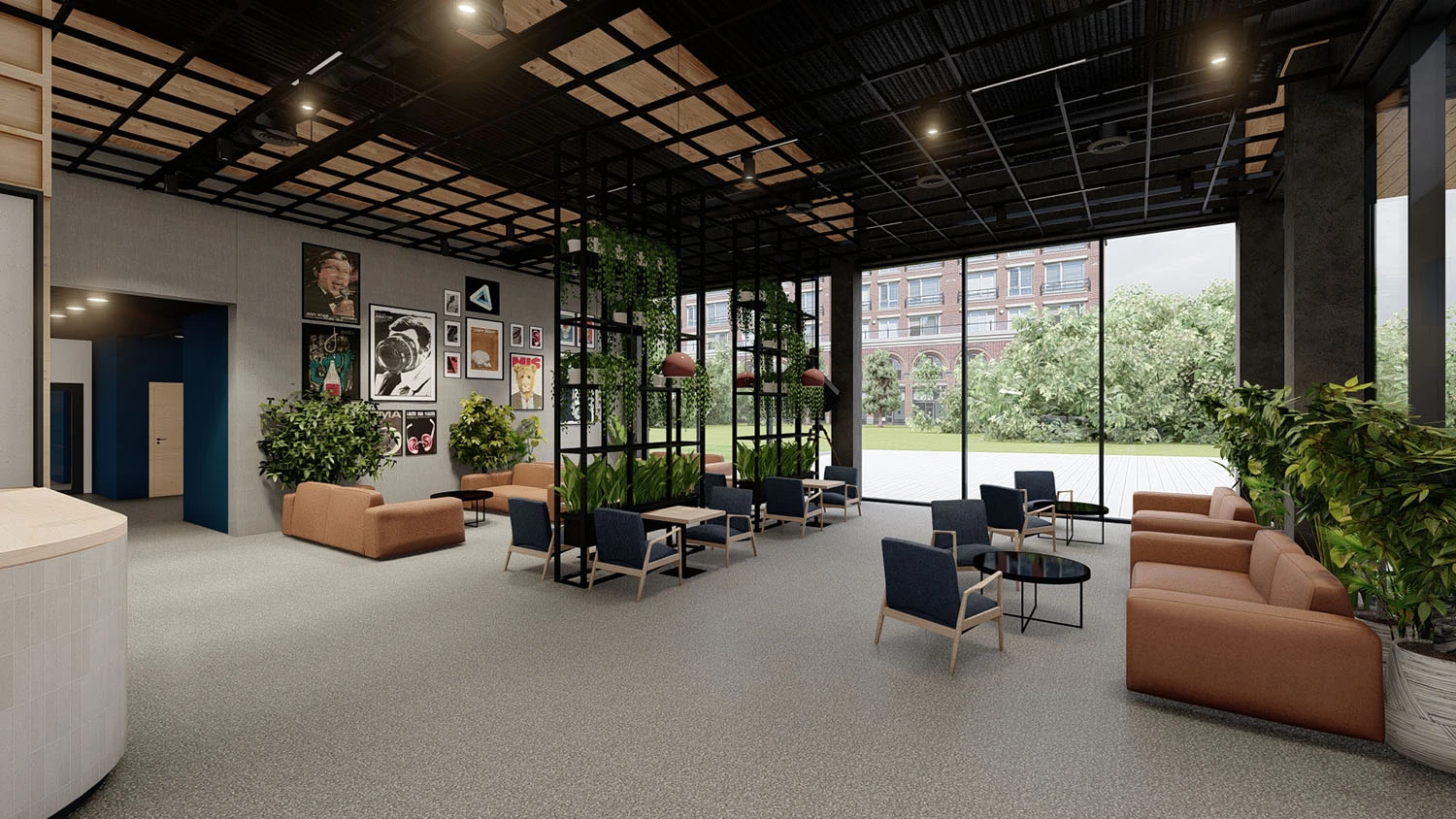
The future social hub of the building has been designed as a place for informal education and integration. The café will be open not only to Educational Center visitors but also to the local community. Its interior will follow a loft style, where raw technology becomes a decorative element.
The space will be divided into an order area with a stunning counter and display cases, and a relaxation area separated by a unique metal wall covered with plants.
In addition to film posters and LED neon signs, the walls will feature “props” – authentic, used film set elements repurposed as unique architectural details.
Full ceilings have been replaced with an openwork grid construction made of deep black aluminum profiles. Above the grid, ventilation ducts and installations, also painted black, remain visible, emphasizing the building’s technical character.
-
Exhibition Zone
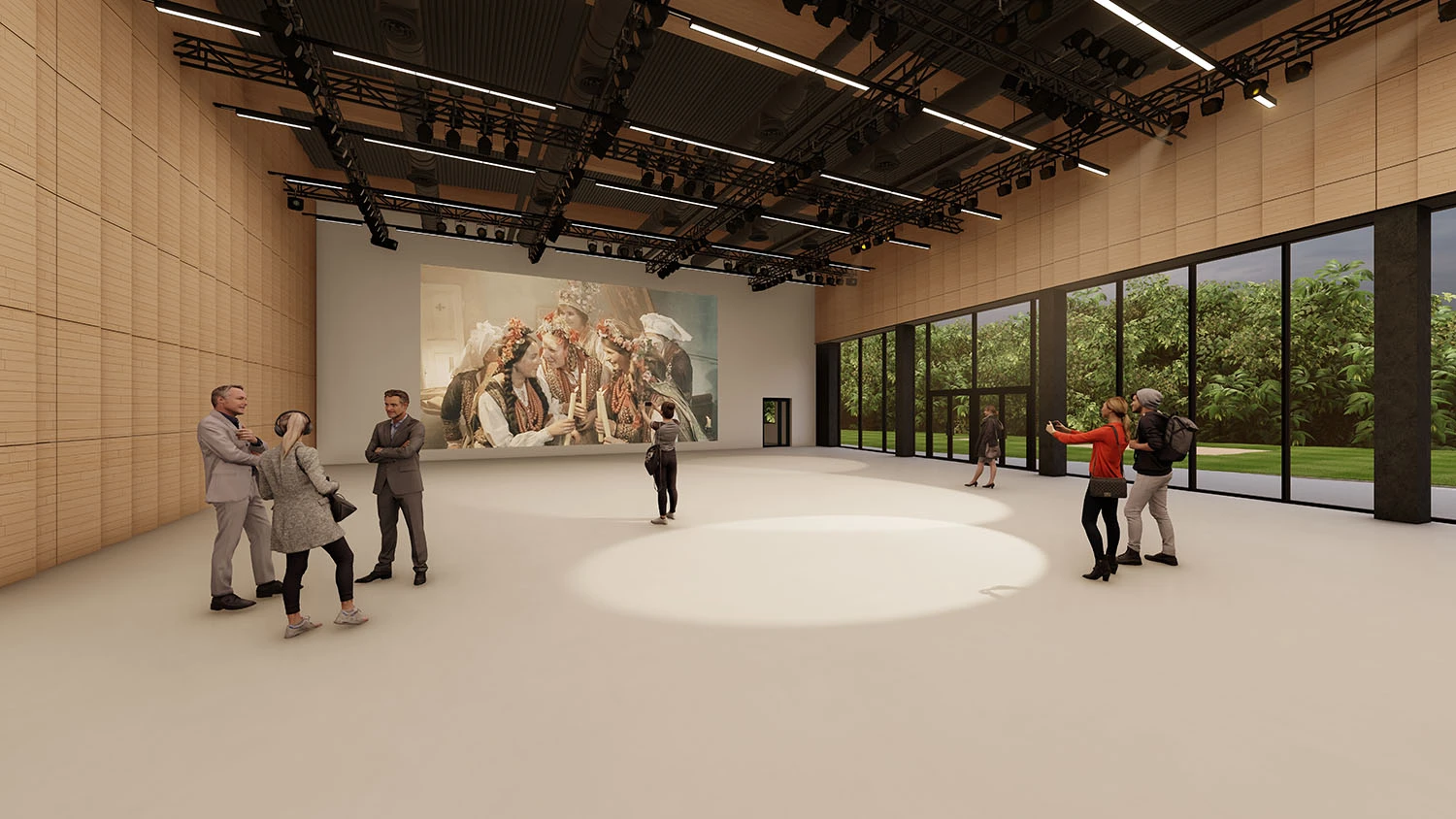
On the ground floor, the exhibition area of over 360 m² will offer a completely different atmosphere. The industrial “coolness” will give way to warmth and elegance.
The centerpiece will be a “Photo Wall” – a modern scenic element encouraging visitors to interact and capture their visit. Neutral-colored walls and a raw, elegant floor will form the backdrop for exhibits.
Unlike the rest of the building, the ceiling will disappear entirely, revealing an impressive roof structure made of glulam beams with varying cross-sections. This will give the tall interior rhythm and a monumental character.
-
Media Library and Audio Library
Located on the upper floor, the media library (over 228 m²) will become a quiet zone designed for comfortable learning.
The space will be divided into a computer workstation area providing access to WFDiF digital resources, and a relaxation zone with soft sofas and poufs. A dedicated section with TVs and professional headphones will allow individual viewing and listening without disturbing the quiet.
The media library and audio library will provide access to the 35mm.online platform, featuring unique digitized and restored film materials from WFDiF’s collection. Computer workstations with professional monitors and headphones will ensure high-quality image and sound, allowing full audiovisual experiences.
Thanks to modern technological solutions, users will be able not only to watch films but also to explore their historical, artistic, and technical context. The media library and audio library will foster film passion and cinematic knowledge.
Lighting with eye-friendly color and intensity will support concentration. Numerous potted plants will enliven the interior, serving both decorative and microclimate-improving functions.
-
Educational Rooms
The educational rooms of the WFDiF Educational Center will be spaces for calm learning, exploring the world of film, and its heritage. Designed for young people, they will accommodate groups of up to 30. Custom-made spaces will combine functionality with the history of the place.
Thanks to mobile walls with wood-like finishes, smaller rooms can be flexibly combined into larger spaces as needed.
The walls will be finished with top-quality, scrubbable latex paints in white and navy. Selected walls will also feature elements from former film sets (props), reminding visitors of the building’s cinematic origins. What once served as a film backdrop now becomes a real architectural element.
All the rooms are designed with accessibility in mind, providing door widths of at least 90 cm and maneuvering space for people with disabilities
-
Cinema Hall
The technological heart of the building will be the cinema hall, designed for total viewer immersion. It will feature a Dolby Atmos surround sound system, suitable for both classic film screenings and educational or special events, creating a modern, comfortable film-watching experience for all.
The hall’s structure involves multiple layers. The ceiling will have an acoustic insulation layer, with a visible coffered ceiling below made of mineral wool panels. Acoustic partitions and perforated sound-diffusing panels will be installed on the walls.
The monochromatic black of the walls, ceiling, and carpet will be accented with LED light strips cutting through the space like lasers, alongside warm wooden details in railings, doors, and stair finishes.
The cinema hall will offer accessible screenings for people with hearing or visual impairments
-
Circulation and Wayfinding: Gallery in the Passage
Corridors and lobbies will be more than circulation paths—they will be narrative spaces. Walls will feature large-format film frames and posters, complemented by black aluminum slatted ceilings forming a delicate veil.
A cohesive visual identification system (wayfinding) with black boards and contrasting white text, including Braille and tactile markers, will accommodate the visually impaired.
The Educational Center’s interior demonstrates that modern architecture can transform technical specifications into an atmospheric narrative, creating spaces that inspire, educate, and unite.
-
Design
Contemporary cultural centers are designed to teach through their interior and architecture. They are not just circulation paths or corridors but interactive spaces for visitors, serving as platforms for artistic communication.
The Educational Center’s interiors blend natural materials, industrial rawness, and cutting-edge technology.
The visual foundation of the entire building will be its flooring, treated with painterly sensitivity supported by technological rigor. In the main circulation paths and halls, poured terrazzo in a dark grey color with contrasting light aggregate will be used. This is not only about aesthetics, but also engineering mastery: a uniform 15 mm thick layer is poured directly onto a cement screed, and then it is repeatedly ground, polished, and sealed, creating the effect of a monolithic surface.
-
Community
The future activities of the Educational Center and the Film Park will be directed towards a wide audience, including children, students, seniors, as well as people from other countries. The Educational Center will also be an open space, accessible to all residents of Warsaw who are interested in Polish cinema, film, or exploring knowledge in the field of audiovisual arts.
The building will be adapted for people with special needs. The project puts particular emphasis on accessibility for people with disabilities and those with various limitations, in order to ensure that the building serves all social groups at risk of exclusion.
All architectural barriers have been eliminated in the project of the building. Elevators have been planned to provide access to every floor of the building, ensuring usability for people with disabilities and those with limited mobility, both future visitors and potential employees. At each staircase, a passenger elevator has been designed to serve multiple functions: transporting people with mobility impairments and enabling communication between floors.
Project No. FENX.07.01-IP.04-0090/24 entitled "Modernization of the infrastructure for film preparation, production, and post-production through the creation of an innovative WFDiF (Documentary and Feature Film Studios) film complex, located on the premises of the Documentary and Feature Film Studios in Warsaw at 21 Chełmska Street, STAGE I – FILM EDUCATION ZONE – EDUCATIONAL CENTER AND FILM PARK."
The investment is co-financed by the European Regional Development Fund under the European Funds Programme for Infrastructure, Climate, Environment 2021-2027 (FEnIKS). The investment is co-financed by the Minister of Culture and National Heritage.
#EUFunds #EuropeanFunds #EducationalCenter #WFDiF